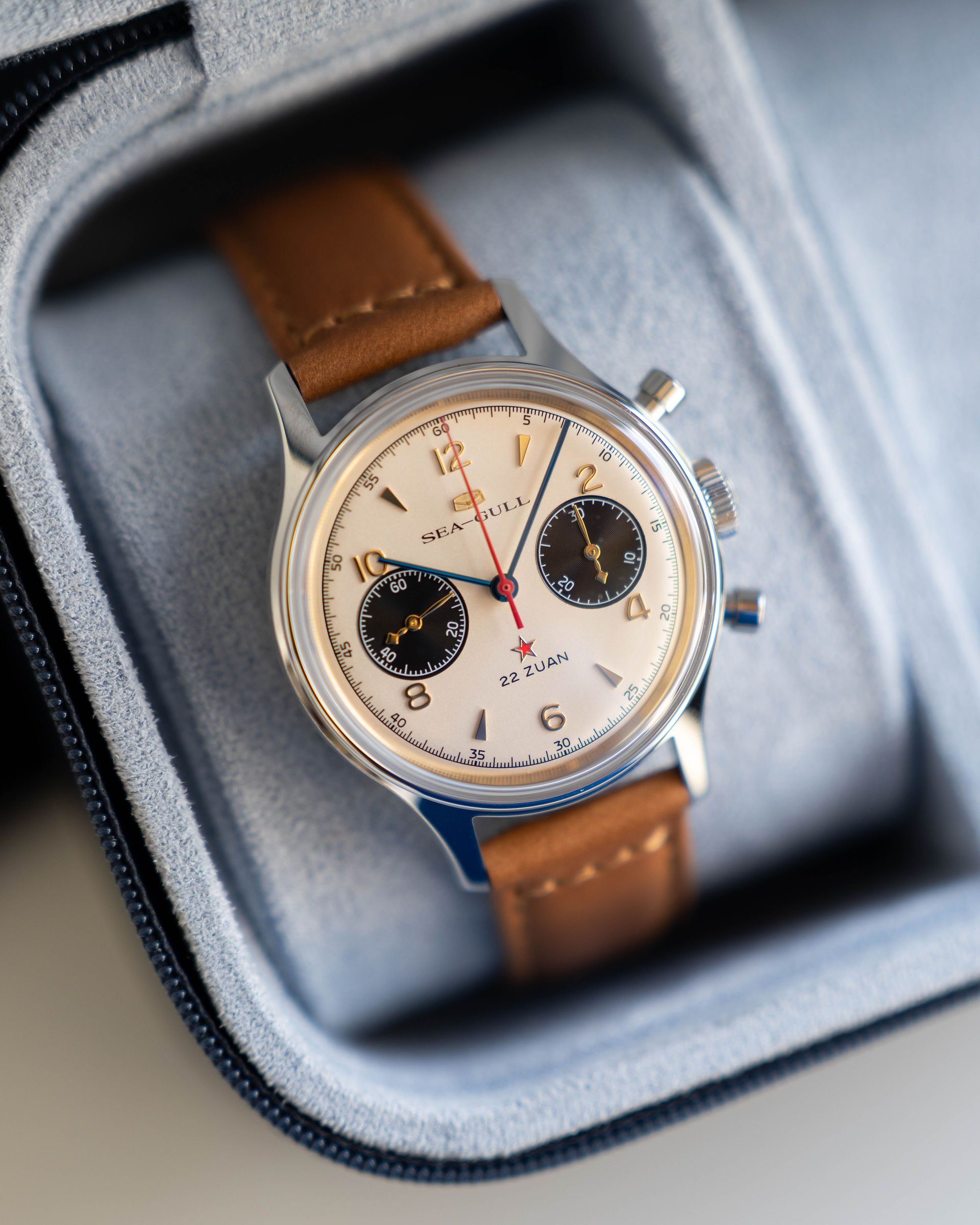
Panda-monium on the Wrist - Not Just a Seagull


Some watches are bought because you fall in love with the watch. Others are bought because of the story that comes with it.
For me, the Seagull 1963 Polar Night Edition Panda Eye Chronograph 37.3mm is very much the latter.
I picked this one up during a recent family trip to Guangzhou, straight from a SEA-GULL boutique at Grandview Mall. It wasn’t planned as a “watch purchase” — but somewhere between walking around Guangzhou, spending time with the family and stepping into a SEA-GULL boutique, this particular 1963 caught my attention.
And there was something strangely appropriate about the version I chose.
A "Panda Eye" chronograph. In China.

If you’re going to bring home a Chinese watch from a family trip to China, it somehow feels right to have a little panda connection on the wrist too, right?
But the more I thought about it, the more I realised that this watch represented something beyond its dial.
The Seagull 1963
SEA-GULL is one of those Chinese brands that I think many watch enthusiasts have encountered, even if they haven’t necessarily owned one.
The company traces its roots back to 1955, when the Tianjin Seagull Watch Factory was established. According to SEA-GULL’s own history, the brand developed China’s first aviation chronograph in 1963 under the top-secret Project 304 for the Chinese Air Force. 1,400 pieces were reportedly delivered to active-duty pilots. Also I find this YouTube video about the brand extrememly informative and interesting. You may access it her
That watch eventually became the inspiration for what we now know as the 1963.
And this is probably why the 1963 has always been interesting to me.
It’s not trying to be a Swiss luxury watch.
It’s not pretending to be something it isn’t.
It has a very distinctly Chinese horological story behind it.
SEA-GULL itself describes the ST1901 as a column-wheel, manually wound chronograph movement, and the 1963 has become one of the brand’s most recognisable models.
The 37.3mm makes a difference
One of the things that drew me to this particular edition was the 37.3mm case diameter. Surpise, not!

There are plenty of larger chronographs around today, but 37.3mm gives the 1963 a much more restrained presence on the wrist. Especially for someone like me with a small wrist size. Yikes!
The official specifications list a 37.3mm diameter, approximately 47mm lug-to-lug and around 15mm thickness. The case is 316L stainless steel, with synthetic sapphire crystal, an 18mm strap and 5-bar water resistance. While the 15mm thickness seems too thick for a 37.3mm piece, but fret not, it's due to the sapphire crystal's elevated position from the watch's case body.
For me, the diameter is definitely the sweet spot followed by its open caseback.
It feels vintage without feeling tiny.
The proportions also make the panda dial surprisingly wearable, especially compared with some of the larger chronographs that dominate today’s market.
And then there is the thing I always find difficult to resist: a mechanical chronograph.
This particular Polar Night Edition uses SEA-GULL’s manually wound ST1901, with 22 jewels and a frequency of 21,600 vibrations per hour. The watch itself weighs 61g.
There is something satisfying about having to wind it.
It makes the watch feel less like an instrument you simply put on and more like something you interact with.
And yes, I wanted the open caseback (I said it again)

Another reason I gravitated towards the 1963 was the exhibition caseback.
Mechanical watches don’t necessarily need to show you what’s happening underneath. In fact, some of the most beautiful watches deliberately hide their movements.
But with the 1963, I think seeing the movement makes sense.
Part of the appeal is knowing that you’re wearing a piece of Chinese mechanical watchmaking history — and being able to turn the watch over and actually see the mechanism working makes the experience that much more tangible.
It’s one of those small things that can make a relatively modestly priced watch feel much more engaging.
The curious case of the 1963 everywhere
One thing that struck me when I started looking into the 1963 again was just how many versions of it are out there.
AliExpress. Taobao. Various “Seagull 1963” online stores. Marketplace listings. Different sizes, colours, specifications and reissues.
It sometimes feels like the 1963 exists everywhere.
And perhaps that’s part of the charm — but it can also make things confusing for someone new to the brand.
Interestingly, SEA-GULL’s current English website explicitly states that en.seagullwatch.com and www.seagullwatch.com are its only official websites, and advises buyers to purchase through its official website or authorised retailers. The brand also cautions that other websites or online stores may carry counterfeit or unauthorised products.
So while the sheer number of 1963 listings is a testament to how popular the model has become, it’s also a reminder that buying a watch with a story sometimes means looking a little deeper into that story.
And perhaps that’s something I appreciate about buying this particular one in Guangzhou.
I didn’t order it from a marketplace.
I walked into a SEA-GULL boutique in China, looked at the watches, tried it on and walked out with it. I also have to stress there was effort put in place to even locate the boutique, as Guangzhou's Grandview Mall is HUGE!
That makes the memory different.
Not my most expensive watch. Probably not my most complicated either.


And that’s exactly why I like it.
In a hobby where it’s easy to get caught up in specifications, movements, finishing, brands and price tags, it’s refreshing to own something simply because it means something to you.
The 1963 isn’t the most expensive watch in my collection. It isn’t the most technically complicated. It probably isn’t even the watch that will get the most attention from another watch enthusiast across the room.
But it has something that money can’t really buy: context.
This was the first time my family travelled to China together.
I’ve travelled to China a few times before — for work and for leisure — and Guangzhou is certainly not an unfamiliar destination to me.
But experiencing China with the family was different.
And somewhere along the way, this little 37.3mm chronograph became the physical reminder of that trip.
A Panda in China

There is also something almost too perfect about the dial choice. The 1963 comes in plenty of variations, but I ended up with the "Panda Eye". A panda-themed colourway, bought in China, from a Chinese watchmaker, during the first family trip to China.
Sometimes the watch chooses you. Or at least that’s what I like to tell myself.
The panda connection may be a little tongue-in-cheek, but that’s part of the fun. Not every watch purchase needs to be serious. Sometimes it’s enough that you look down at your wrist and remember where you bought it, who you were with and why you chose it.
More than just a 1963
SEA-GULL today is obviously much more than the 1963.
The brand’s own history spans seven decades, from its beginnings in 1955 to its work in high complications, including tourbillons, minute repeaters and perpetual calendars. SEA-GULL also describes itself as China’s largest manufacturer of mechanical watch movements, producing more than two million movements annually.
But the 1963 remains particularly interesting because it sits at the intersection of all of that history.
It is mechanical.
It is Chinese.
It has a military aviation heritage.
Perhaps most importantly, it has become accessible enough that you don’t need to spend a fortune to experience a piece of that story.
For me, however, this particular 1963 is no longer just about Chinese watchmaking.
It’s about family, travel and memories.
One day, I might forget exactly how much I paid for it.
I might even forget the technical specifications.
But I’ll probably remember walking into that SEA-GULL boutique in Guangzhou, with my family on that trip, looking at the watches and deciding that this was the one coming home with me.
And that’s probably what makes it worth having.
A watch doesn’t always need to be valuable. Sometimes, it just needs to be meaningful.